You Really Can Build a Tornado/Hurricane Proof Home
by Dan Powell
So why are you here? You were obviously looking for something that related to tornado proofing or tornado resijstance and that is what we have written about. The issue is: can you tornado proof your existing home. For many of you that answer is: probably not, as it will cost more than you want or can afford. For others, maybe, but any retrofit will cost more than it would have cost had it been done from the beginning.
What I am trying to do here is to show you that there is a better way to build, that will get the job done without a lot more cost, so read on and then search the web, I believe that you will not find a better answer, one that is both cost effective and energy efficient, beautiful and comfortable, bullet proof and long lasting.
As you will read I have covered a wide range of building practices that are common throughout the US and discussed their merits and failures. As a licensed Contractor I've used many of these and seen them all first hand. I currently live off the grid in a rammed earth/bermed home that cost less than 15k when it was built 15 years ago.
Anyone can own their own home that is tornado proof! Let us show you how.
Introducing the new entry level automatic block press:
(still made in America!)
Email me dan@adobemachine.com
Please review this link at our main tornadoproof website at www.tornadoproof.us ! our contact emails and phone numbers are on that page as well as the bottom of this one.
The last time I updated this page was in 2011 right after the destruction of both Joplin and Tuscaloosa as well as the surrounding areas. Today is June 4 2013 and the Oklahoma city area has been slammed twice in the past month! We extend our condolences as well as our sympathies to those of you who have lost so much. We would also like to offer a way for you to NOT have to go through this again! We do offer a solution and it will not cost much more (if any more) than a standard stick frame home! Plus our homes have a lot of benefits you would not get! So Call Vaughn, Blake or me (Dan) and we'd be happy to talk to you about rebuilding!
So while we are digging out of the housing bubble collapse, the monetary system collapse and the stock market collapse, and while we are paying more for energy than ever, and while the government seems to be the only business that's growing let's not forget that the little pigs that built out of sticks and straw were eaten by the wolf!
Actually this year has been pretty good for the CEB business and our customer base has increased globally but I am disappointed in that even our esteemed leaders remained ignorant of the tragedy of the demise of the manufacturing business in this country along with the real jobs that left with them.
If you are inclined to see what we're up to come back in a couple of months and see if there is a new link somewhere around here.
This article is designed to not only inform of tornadic resistant building but to propel those with the means to enter this endeavor. With the construction boom virtually at a standstill and most of the big players begging for business the publics demand for tornado resistant, green homes can be heard.
We have recognized the need for home owner/builder machines and have made them available. We have recognized the need for a building block that can be handled easily by women and teenagers, this too is now available.
If you are like the the vast majority of us your home is your single largest asset. So build it to last, make it green and make it SAFE.
My Email - Dan Powell
For many years the Earth Construction Industry has concentrated on seismic resistant construction in the Western U.S. resulting in acceptable building technology for most areas, however for many reasons the rest of the country has been resistant to or ignorant of this remarkable product.
Some of these reasons are:
Cheap lumber, Builders who know only stick frame construction, Uninformed home buyers, poor marketing, low quality machinery, High prices, insufficient systems, and more.
Even with the cost of concrete, lumber, steel and energy skyrocketing the naysayers as well as the stodgy lending and insuring bureaucracies have been resistant to alternative construction. This, however, is changing, with the demise of billions of dollars worth of real estate the insurance industry is rethinking their marriage to the lumber industry and that is of course followed by the lenders.
First we need to address some of the issues and realities of some “modernâ€ン construction methods.
As a contractor I am familiar with many building techniques and the necessary methods used to achieve them, so we’ll explore these.
Stick frame construction, wood:
Wood frame, either 2 x 4 or 2 x 6, is by far the most prevalent building material in the U.S. and the least costly as well as the least energy efficient, least lived and least structurally resistant to wind damage. Using standard building techniques the studs are nailed through the plates strait into the ends of the studs then the bottom plate is bolted to the foundation on 4’ centers. Plywood or oriented strand board (OSB) is then nailed or stapled to the top and bottom plates and the studs. The cap plate is nailed to the top plate with a slight angle with the trusses toe nailed to the cap plate with hopefully a sheet metal angle bracket (hurricane strap) nailed to the truss and the two top plates using a total of 10 8d nails per truss end . Most codes don’t require solid plywood sheathing and allow either cellulose fiber board or gypsum board for everything but corners, I’ve seen many homes without any wood sheathing at all. Wood trusses on 24â€ン centers with 7/16 wafer board or 5/8 cdx plywood decking is common. It is also common to use a brick veneer for the exterior finish making the walls resistant to light projectiles but does not address the roof attachment which is marginal at best.
Stick frame construction, metal:
Metal frame is an improvement over wood with the fastening using screws and or ramset hardened nails but most sheathing is gypsum board. The trusses are attached with metal brackets allowing for better wind lift resistance but the walls are easily penetrated and deformed by wind driven projectiles.
Panel construction:
A huge improvement over stick frame as the interior as well as the exterior has 7/16 OSB sheathing with an injected foam core for insulation and strength, The panels bolt together and down to the bottom plate and are tied together with the top plate. Roof attachment with roof panels offers a huge improvement to resisting wind lift if used otherwise the roof is the same as with stick frame and is as subject to wind lift. The resistance to projectiles is slightly higher and the walls are less likely to collapse when hit by a large projectile.
Brick construction:
This is usually seen in older commercial and some expensive older homes, much stronger than frame construction but the outer layer detaches from the inner layer due to deterioration of the metal fasteners by corrosion as well as mortar degradation over time. This type of construction is much more resistant to wind lift with adequate roof attachment as well as penetration by projectiles other than cars and large trees. The energy use for the manufacture of brick is rather high (2 to 3 MJ/kg) though less than wood products amazingly (2.5 to 10 MJ/kg) see chart. There are a lot of pollution issues as well. See Environmental report.
Concrete construction, concrete masonry units (CMU):
In many parts of hurricane alley the CMU is the mainstay of hurricane resistant construction. With concrete cores and steel reinforcement CMU wall can take a real battering as well as offering a foundation attachment to the roof which is either concrete or metal. On the down side is horrible energy performance and sweating. While these homes are very strong they are generally built with a lot of windows and doors to make them comfortable so vulnerability to tornadic winds is also a problem.
Concrete construction, Insulated concrete forms (ICF): The only place I’ve seen these are in the U.S., I would imagine that they are also available in Europe as well, as they utilize either molded Styrofoam (Foam form) or expanded polystyrene beads in cement slurry formed into a block (Rastra). These have the same advantages of CMU construction without the liabilities of high conductivity and clammy rooms. If you don’t mind the 3 to 4 times construction costs as well as the huge embodied energy usage you will be well served by this construction type however you will be contributing the global warming problem.
All of the wood products can be improved by the use of foundation to roof tie downs as well as wood wall sheathing, a brick or rock veneer at least 3â€ン thick and a roof membrane that ties to the walls rendering the roof wind resistant to all but the most violent of tornados. As this will not prevent damage from flying trees, cars, boats, and Mobil homes (tornado bait) it will prevent damage from your neighbors house as it explodes.
Earth Construction, Berm or dug in:
Typically a concrete retaining wall of either ICF or solid reinforced concrete is built on 3 sides into the side of a hill or bermed with earth typically 10 or more feet thick. With a low pitched roof, usually earth, these homes are extremely energy efficient (see note) and with proper orientation and well designed can be very comfortable. usually the exposed side is frame or ICU with a large area of glass for light and solar exposure.
Note: The actual efficiency is compromised to a degree by the energy required to construct it using large quantities of both steel and concrete. (source) By my calculations the energy used for Concrete is roughly 1.026 MJ/kg vs .26 MJ/kg for Earth Block (my figures) The steel used for reinforcement adds to the disparity. (here is another source for embodied energy with numbers)
Earth Construction, Rammed Earth:
This home looks like any other but that is where the likeness ends. with 18" to 24" thick walls compacted with a mixture of soil and 6% portland cement you can sleep through any storm, I believe this construction could survive a mild storm surge given a proper foundation. Any roof system can be installed on this massive structure that will last for many generations. Extremely energy efficient but comes for a pretty price.
Earth Construction, Adobe:
Built from cast mud brick the adobe home is the most common structure on the planet. From the Middle East to South America adobe brick has been used to build every thing from castles to mausoleums. The city of Babylon and the city of Santa Fe were and are primarily adobe. Walls are from 8" to 48" thick depending on your need for thermal mass and or protection. The truth is you can never have too much dirt in your walls (unless they are frame) Like the rammed earth home these are wonderful legacy homes that will save you a ton of money in energy bills and like the rammed earth home it is quite labor intensive and expensive to have built but cheap to build your self. Not nearly as tough as the rammed earth house but actually more comfortable. I've lived in an adobe home since my childhood and prefer the feel of non cemented dirt.
Earth Construction, Compressed Earth Block (CEB):
CEB is the construction industries answer to the affordable legacy home. With massive walls 10" to 48" CEBs can be produced with very little energy. (less than .26 MJ/kg) yet create a thermally stable, tornado, hurricane, fire and bullet proof home that will last for hundreds of years if not more. As the precision block are simply stacked without the need for mortar (making them earthquake resistant) and without the need for skilled masons, The CEB system is fast and competitive allowing the median income home owner to obtain this Legacy Home
There are many other home building systems that are available with a simple search on the Internet. Most are not suitable for fast track builders.
If you are an owner/builder that would like more information about our owner/builder machines check out our new Brickmaker and Blockmaker series of machines to see a cost effective way to build your own Legacy Green Home!
If you are a contractor who wants to enter the Compressed Earth Block industry armed with the best machinery as well as machinery designed for your aspirations come see us at www.adobemachine.com and use our site for your education then drop us an email or call us when you are ready to begin this remarkable endeavor.
Just a word in case you are worried about the economic storm looming on the horizon. I see it everywhere I go and frankly haven't known what to do up until a few days ago. I have begun to depend upon the internet for any REAL information and I believe the information presented here to be not only true but relevant!
Dan
For a general overview of all types of
construction check out PORCH.COM at their
advice page at Home
Construction and Natural Disasters: How to design ...,

Tornado damage note projectile in gable
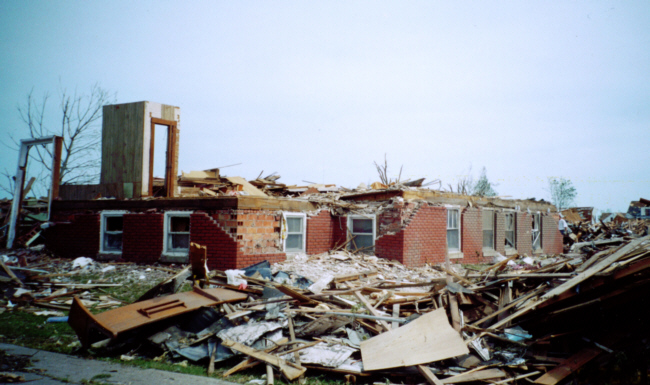
Tornado damage brick building
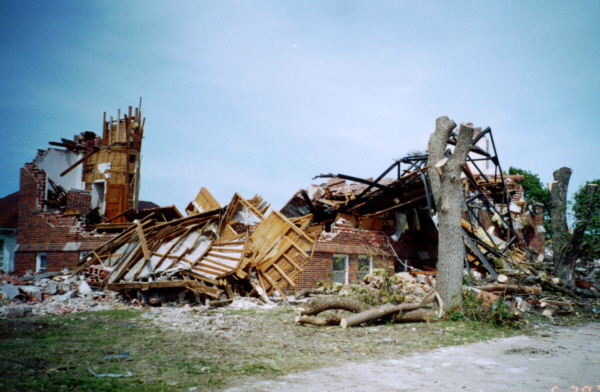
Tornado damage stick frame with brick veneer
?
The real question is:
Can you as an individual and can we as humanity afford to continue building disposable homes?
Yes you can build a stick home that is wind resistant but not projectile resistant.
Yes you can build a concrete home that is both but why would you want to? Considering the energy costs both in embodied as well as ongoing you very well might not be able to afford the cost and the planet sure can't.
CMU home with concrete roof North Coast Dominican Republic
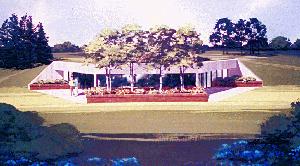
Bermed Construction
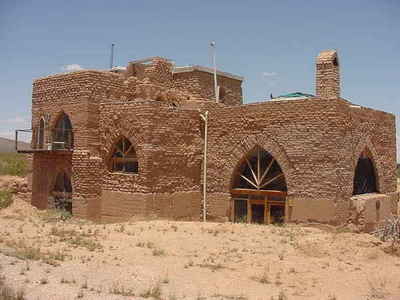
Adobe home Columbus N.M.
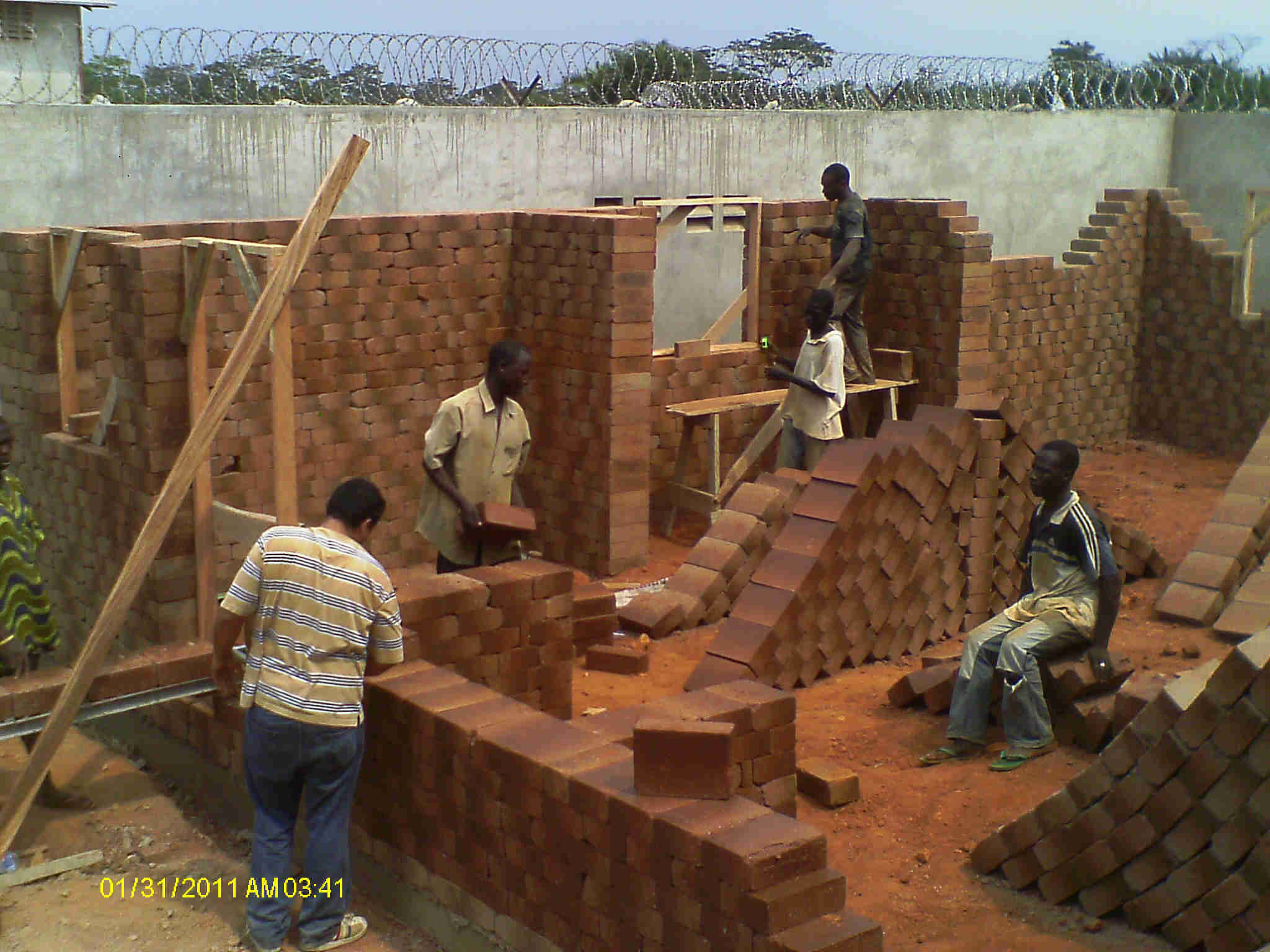
CEB home under construction Ikurodu, Lagos, Nigeria
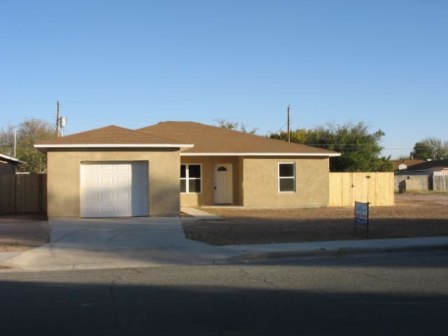
CEB home Midland Texas U.S.
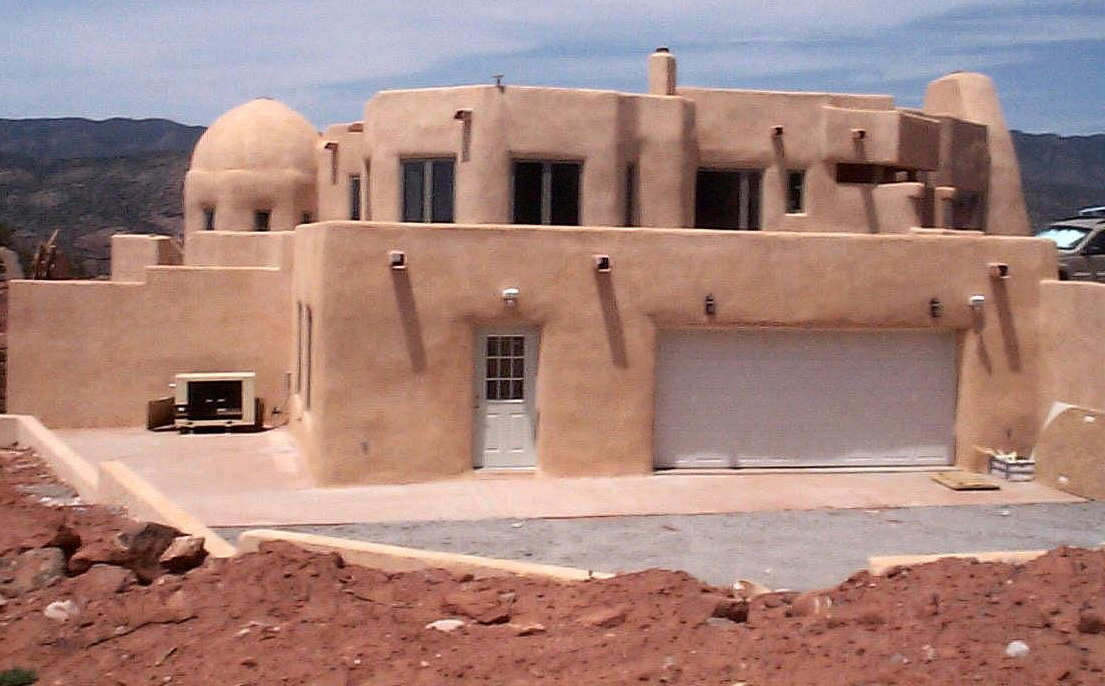
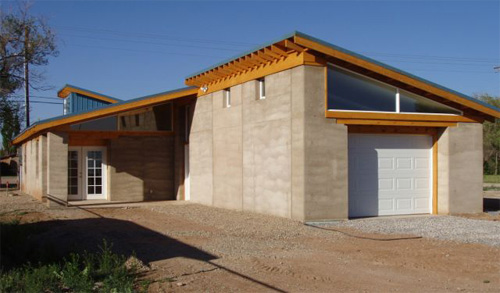
CEB home New Mexico, U.S.
